This article provides professional guidance. Suitability, execution and legal requirements must always be assessed for the individual property.
Three letters become practical decisions
Environmental, Social and Governance describe three connected perspectives: the use of resources, responsibility for people and reliable business processes. ESG is therefore neither a product label nor a promise that a single measure is automatically sustainable.
For skilled trades and building services, the questions are practical: Can an existing surface be preserved? Are work methods safe and realistic? Can the selected service, responsibilities and result be documented? This is where abstract requirements become decisions on site.
Why clients increasingly request ESG information
EU sustainability reporting rules address companies above defined size thresholds. These companies need information about environmental and social risks, impacts and their value chains. Smaller suppliers may therefore receive structured questions even when they are not themselves directly subject to mandatory reporting. [1]
EFRAG's voluntary VSME standard is designed for non-listed SMEs. It helps them answer data requests from larger companies, banks and investors in a more consistent way. Voluntary does not mean irrelevant: transparent information can make qualification, financing and procurement discussions easier. [2] [7]
E: preserving materials before replacing them
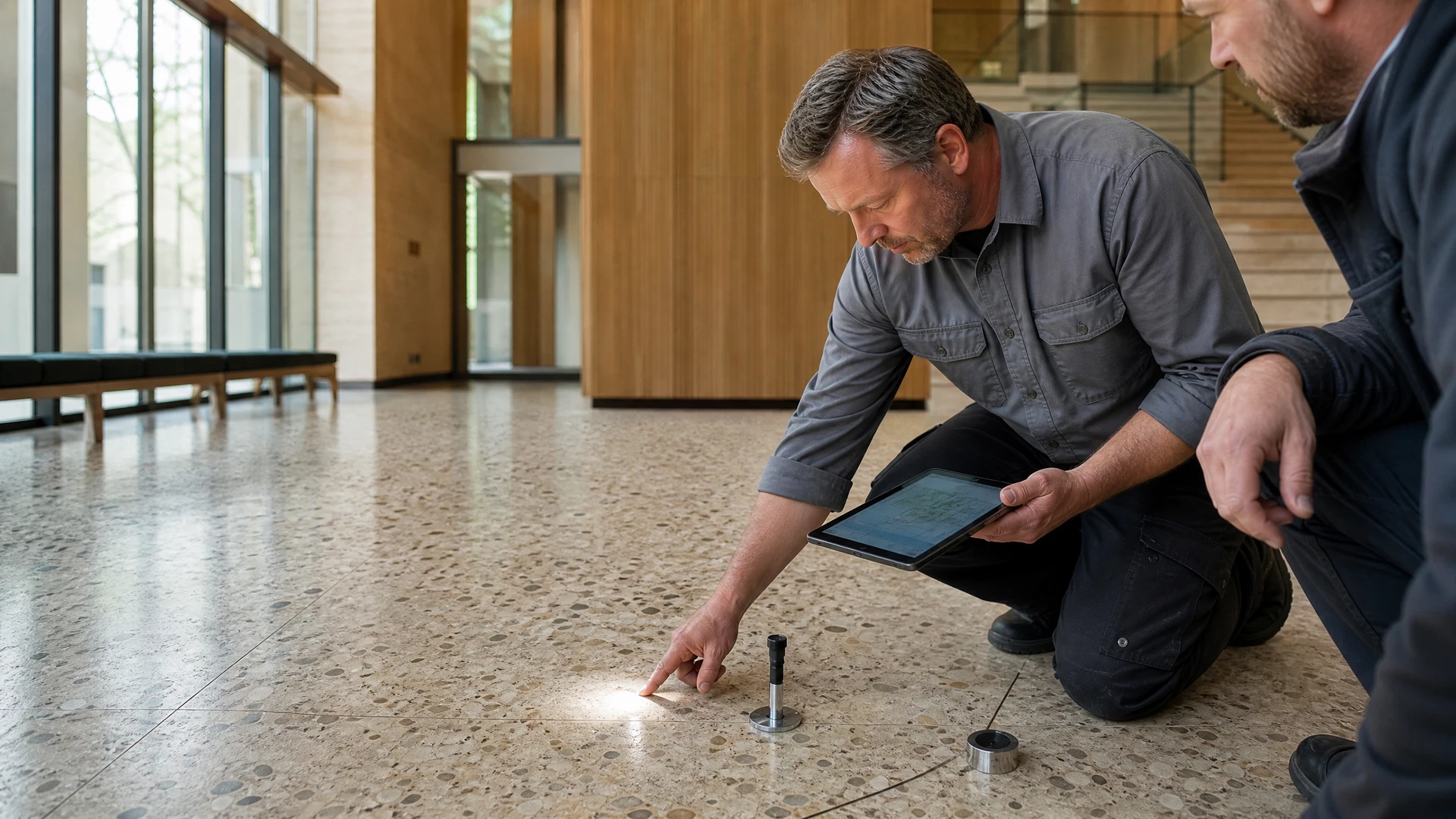
The European Environment Agency expects most of today's buildings to remain in use in 2050. Its analysis identifies extending the life of existing buildings and reducing demand for new materials as central circular renovation approaches. [3]
For floor work, this supports a clear sequence: assess first, then decide whether cleaning, repair, sanding, protection or replacement is technically appropriate. SteinWert can help preserve suitable natural stone, terrazzo and resilient floors. A specific carbon or resource saving, however, requires a project comparison and must not be assumed in advance.
S: quality depends on people
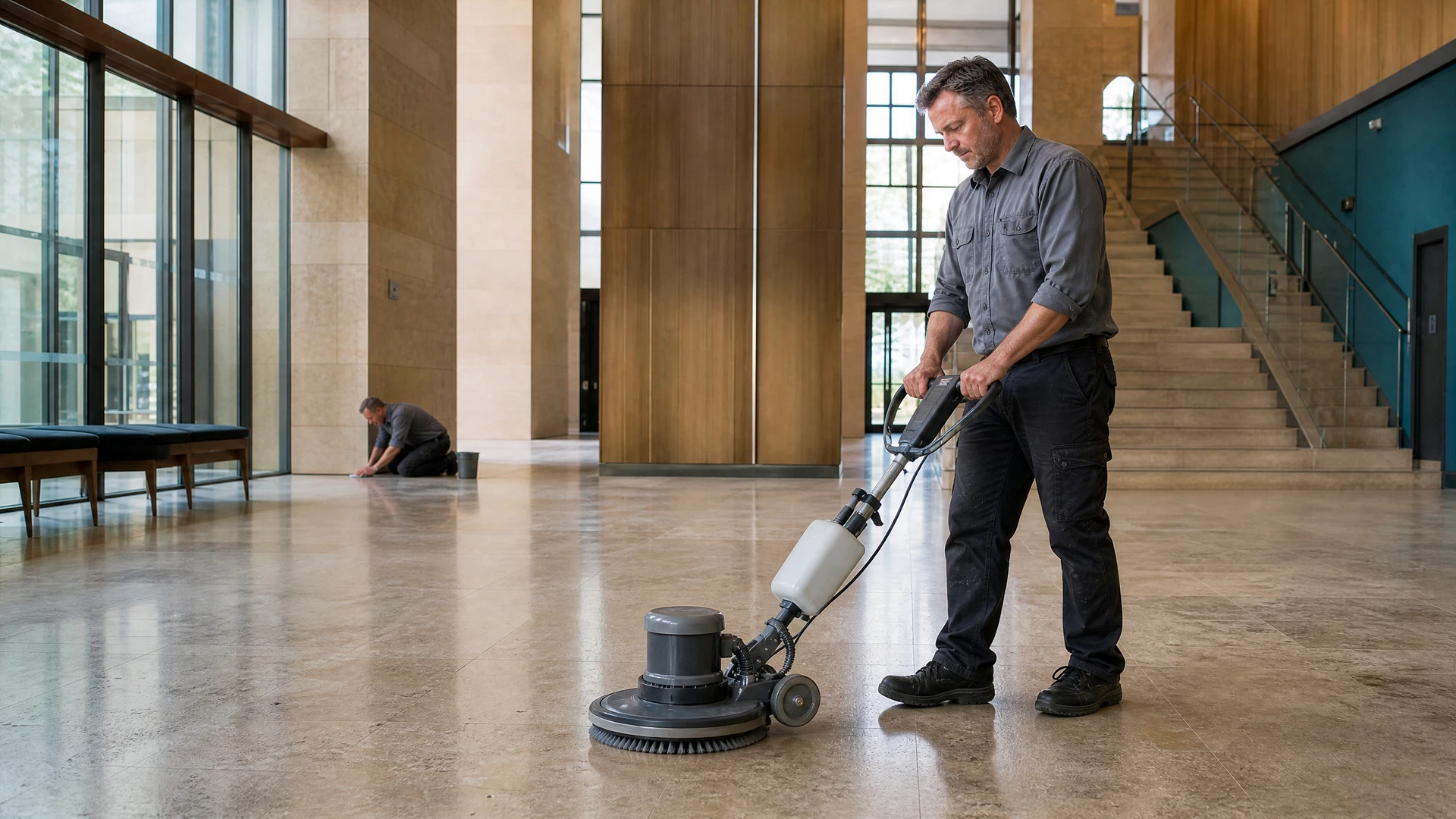
Professional results depend on trained employees, safe equipment, realistic time windows and clear coordination with the property. Occupational health and safety, qualification and respectful deployment planning therefore belong to the social dimension just as much as the visible finish.
Technology can support this approach. Mechanised processes and cleaning robotics may relieve teams on suitable, recurring areas, while assessment, detailed work and quality control remain human responsibilities. The aim is not a replacement promise, but a workable combination of expertise and technology.
G: evidence is stronger than a slogan
Governance becomes visible through responsibilities, approvals and records. A documented assessment, comprehensible scope of work, agreed quality checks and transparent offers make decisions easier to review later.
This also matters in procurement. The EU provides voluntary green public procurement criteria for indoor cleaning services and emphasises verifiable requirements. [4] SteinWert therefore focuses on property-specific procedures, suitable equipment, controlled dosing and documented service modules rather than broad claims such as ‘chemical-free’ or ‘ESG-neutral’.
How SteinWert can support today
SteinWert combines skilled floor refurbishment and building services: preserving suitable existing surfaces, planning material-compatible cleaning, integrating modern technology where it fits and making services transparent. This provides useful building blocks for clients who document environmental, social and governance measures.
It does not replace the client's sustainability report, life-cycle assessment or legal review. The contribution is operational: accurate property data, a justified treatment decision, clear responsibilities and evidence that can be incorporated into the client's own ESG process. German trade organisations likewise point to repairing, preserving and refurbishing as practical sustainability contributions. [5] [6]
What to check on site
The decision starts on site.
- Record the existing material, condition and intended use before choosing a measure
- Compare refurbishment and replacement on a project-specific basis
- Define occupational safety, access, time windows and responsibilities
- Agree on cleaning methods, dosing, technology and quality checks
- Specify which service and property data the client needs for its ESG documentation
Frequently asked questions
Clear answers for the next step.
Is SteinWert ESG certified?
This article does not claim an ESG certification. SteinWert supports clients through concrete, documentable services such as condition assessment, value preservation, property-specific cleaning and quality control. The client decides how these data fit into its ESG system.
Does floor refurbishment always save carbon compared with replacement?
That cannot be promised in general. A robust assessment must compare the initial condition, technical suitability, material quantities, processes, transport, service life and the actual replacement alternative.
Which evidence can a client use in its ESG process?
Useful information includes traceable area and material data, the justified scope of work, methods used, agreed quality checks, responsibilities and documented results. The exact data requirement should be agreed before the project starts.
SteinWert consultation
Would you like to make floor preservation or building services more transparent for your ESG process? We assess the property and define verifiable service modules with you.
Sources and notes
[1] Europäische Kommission: Corporate sustainability reporting
[2] EFRAG: SMEs and Sustainability Reporting (VSME)
[3] Europäische Umweltagentur: Building renovation – where circular economy and climate meet
[4] Europäische Kommission: Green Public Procurement Criteria and Requirements
[5] Zentralverband des Deutschen Handwerks: Nachhaltigkeit
[6] Deutscher Nachhaltigkeitskodex: Zukunfts-Kompass Handwerk
[7] EFRAG: VSME Introduction – Objectives, structure and principles