
This article provides professional guidance. Suitability, execution and legal requirements must always be assessed for the individual property.
The right question is not first: new or old?
Natural stone is used in everyday life. Traffic marks, fine scratches, matte zones, or individual stains are therefore initially observations – not a final diagnosis. Before a surface is replaced, a condition assessment is worthwhile: What type of stone is it? How deep is the damage? Are there indications of moisture, hollow spots, joint problems, or a stressed substrate?
This sequence creates clarity. A purely visual refreshment can be useful if the cause lies on the surface. If the damage comes from the substrate or from permanent moisture entry, the measure must be considered further. This is precisely the difference between short-term cosmetics and a technically justified renovation decision.
Material knowledge protects against incorrect care
Calcareous stones such as marble or limestone react differently than silicate rocks. Therefore, cleaning should not be chosen based on visible dirt alone. The Natural Stone Institute recommends understanding the geological and chemical classification of the material as a starting point for care decisions. [1]
Sand and dirt on floor surfaces are more than just a cleanliness issue: they can have an abrasive effect. At the same time, unsuitable, especially acidic cleaning products can attack calcareous surfaces. A well-maintained surface therefore begins with dirt avoidance, suitable tools, and a process that fits the material.
Cleaning, grinding, or repairing?
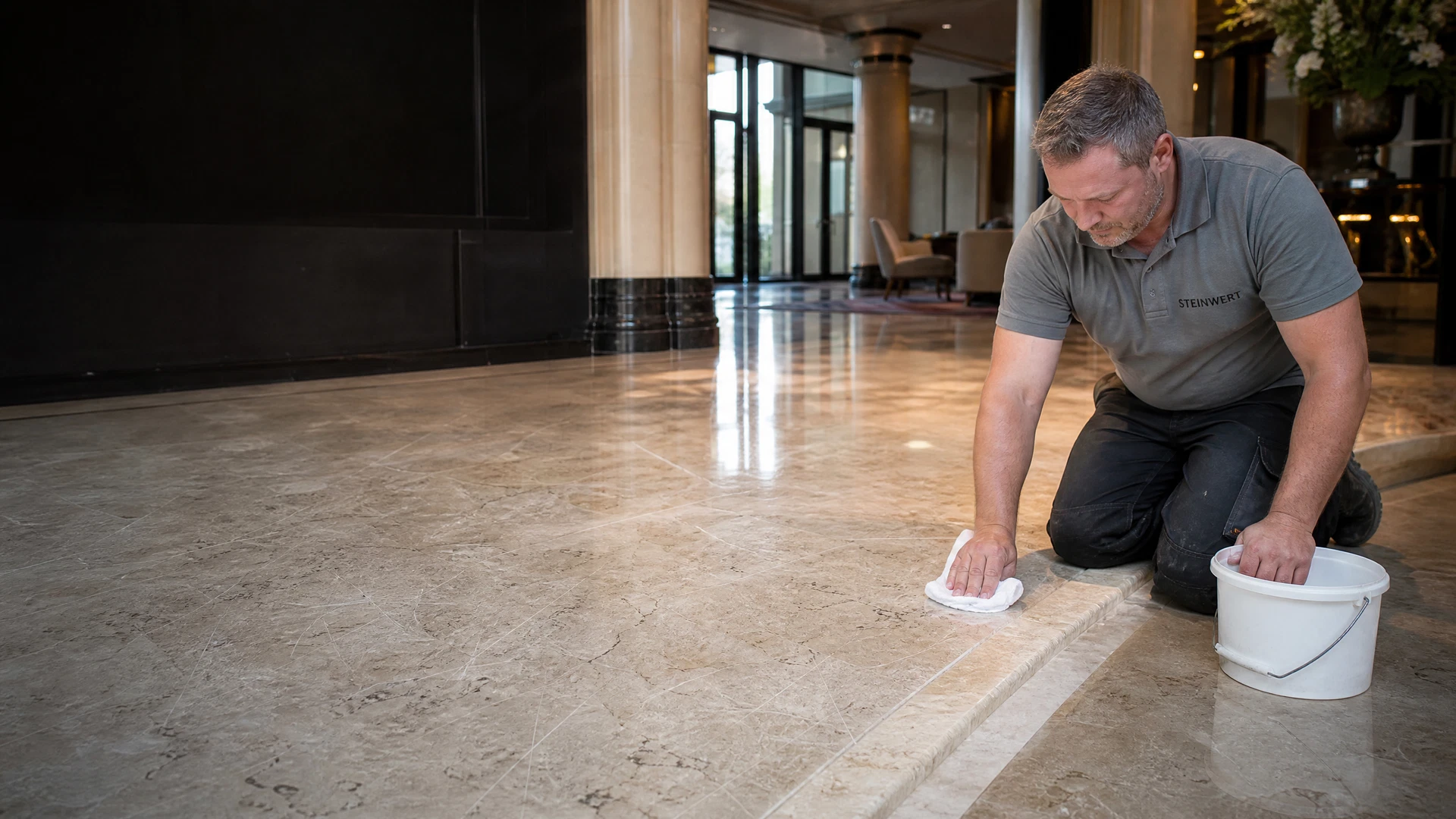
Which treatment is suitable depends on the damage. In the case of residues or an unsuitable care film, material-appropriate basic cleaning can already achieve a lot. Scratches, acid burns, or uneven traffic zones may require multi-stage grinding. Individual breakouts or edges are in turn evaluated differently than large-scale loss of gloss.
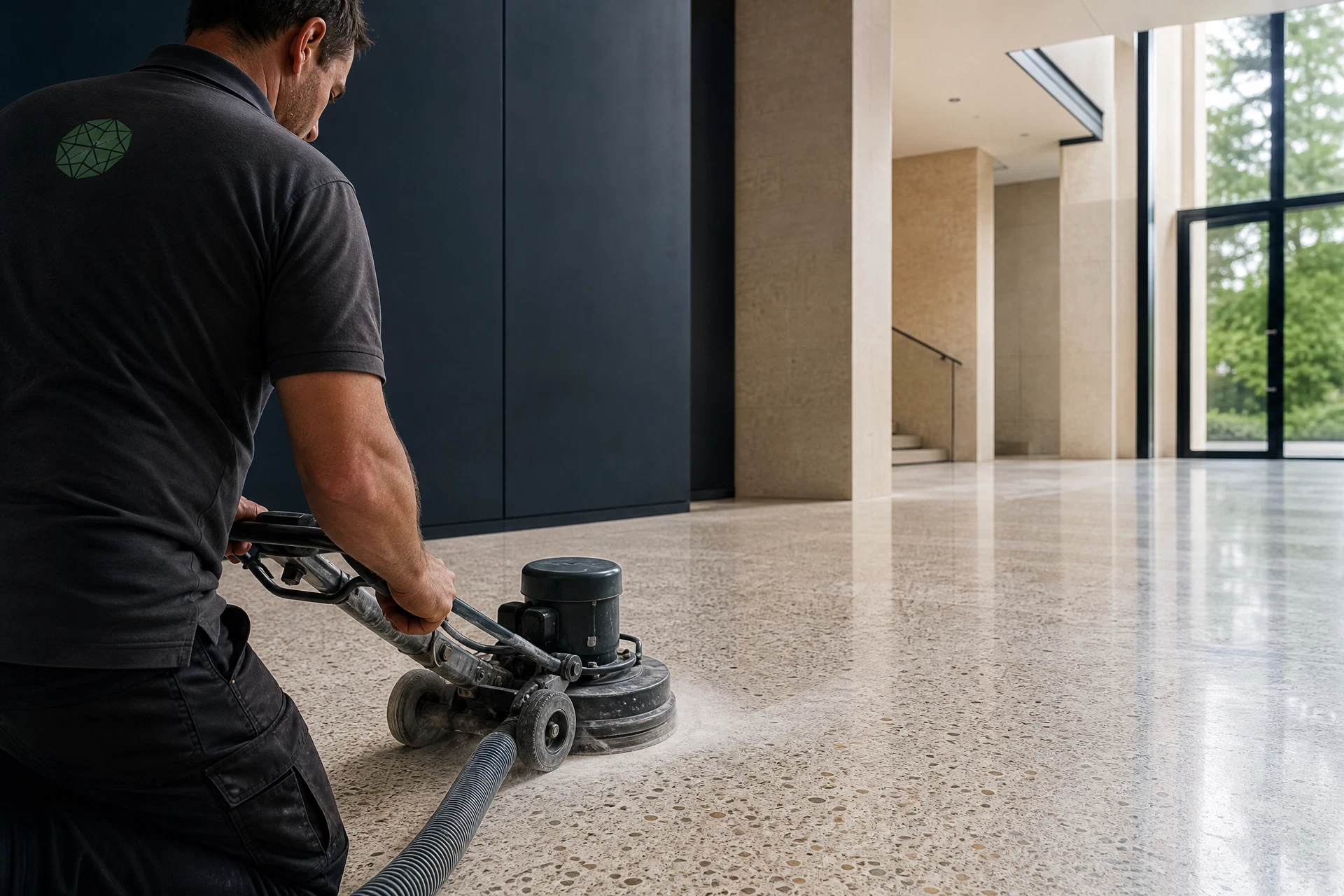
The technique always follows the target image and the existing material. Grinding, polishing, and protective treatment are not a standard sequence for every surface. They are planned so that appearance, use, and any required slip resistance fit together.
Protection is no guarantee
Impregnations can increase the stain resistance of a suitable surface. However, they do not make natural stone stain-proof and replace neither proper cleaning nor a quick reaction to spills. [1] The condition of the existing protective treatment therefore belongs in every condition assessment.
In this sense, preserving value does not mean shielding a surface from every use. It means understanding signs of use early and reacting with a suitable, traceable measure.
What to check on site
The decision starts on site.
- Determine stone type and surface finish
- Classify damage as superficial, structural, or moisture-related
- Check joints, substrate, and connections
- Coordinate use, dirt entry, and desired appearance
Frequently asked questions
Clear answers for the next step.
When is restoration preferred over replacing natural stone?
Restoration is technically appropriate if the stone substance is structurally intact and only surface damage such as scratches, dullness, or stains is present. Targeted refurbishment preserves the original appearance without changing the material. Whether restoration is possible in an individual case requires an object-specific inspection of the substrate and the damage pattern by a qualified specialist.
Which technical procedures are used in the repair of natural stone coverings?
Depending on the type of stone and the degree of wear, processes such as level grinding, polishing, or crystallization are used. These methods minimally remove damaged layers and restore the desired surface quality. The selection of specific processing steps and the care products to be used must be made considering manufacturer approval and the material-specific properties of the respective object.
How is it ensured that the restoration result meets the technical material requirements?
The suitability of the restoration method for the respective object is verified in advance through sample surfaces or technical analyses. Factors such as absorbency, hardness, and chemical resistance of the stone are evaluated. For the final execution, professional approval is necessary to ensure that the chosen measures are compatible with the specific requirements of the covering and its environment.
SteinWert consultation
Would you like to have a natural stone surface professionally assessed? We check material, condition, and use as the basis for the next sensible measure.
Sources and notes
[1] Natural Stone Institute: Care & Cleaning of Natural Stone