
This article provides professional guidance. Suitability, execution and legal requirements must always be assessed for the individual property.
Suitable Area, Realistic Task
Autonomous systems are particularly interesting where large, largely unobstructed floor areas are processed regularly. The specialist article from Facility Management assigns vacuuming and mopping robotics primarily to these fields of application. [1]
Thresholds, stairs, narrow passages, changing furniture, and sensitive zones can, however, limit the process. An object analysis is therefore more important than a look at the technical equipment alone.
Cobot instead of Replacement Promise
Cleaning robotics can take over repetitive paths and thus relieve specialists. Edge work, detail cleaning, handling special types of dirt, and quality control, however, remain tasks that require experience and situational awareness.
The sensible benchmark is therefore not: How many personnel can be replaced? But rather: Which work steps can be supplemented safely, traceably, and in a material-appropriate manner? In this understanding, the robot works as part of a team.
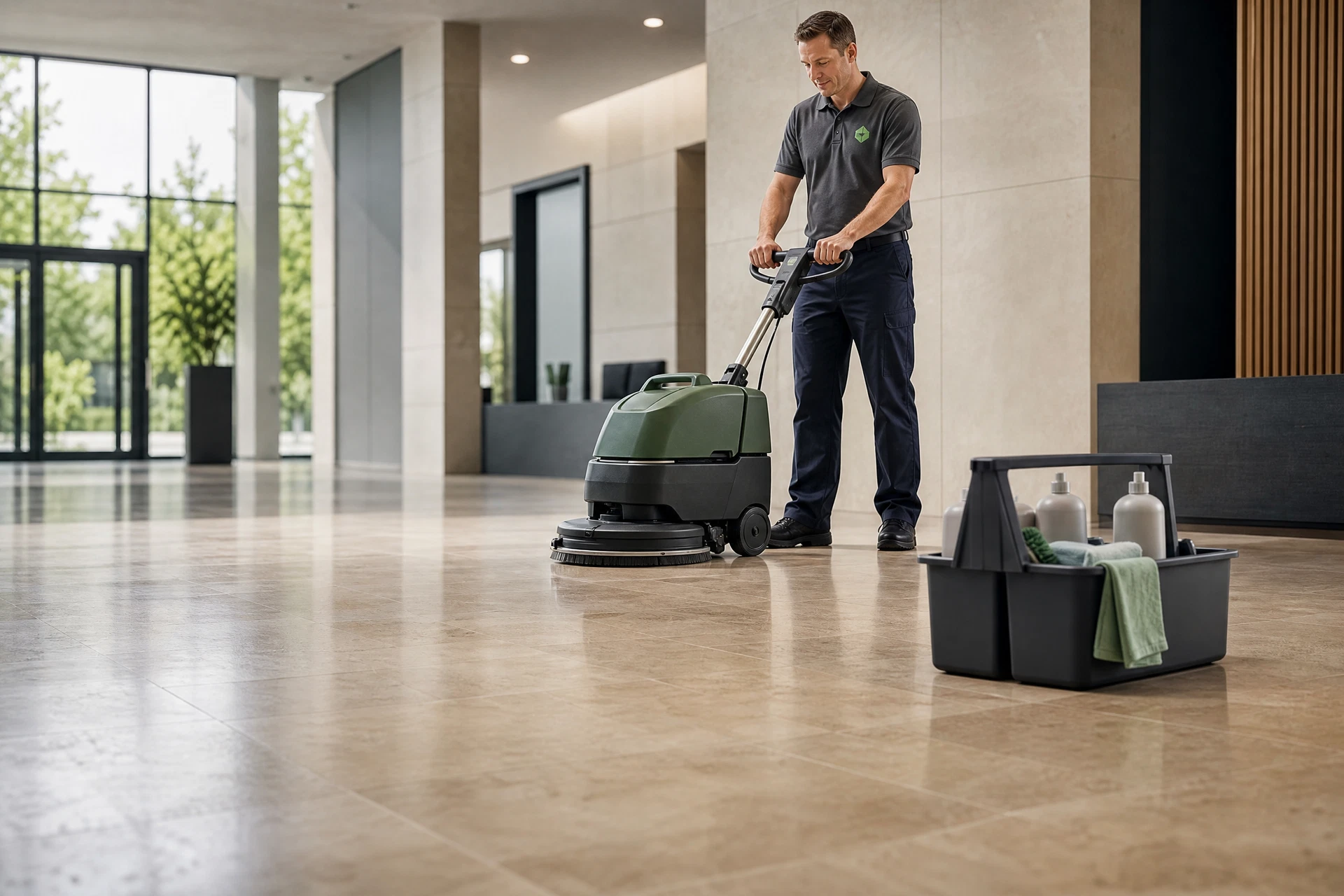
Infrastructure is Part of the Solution
Mapping, parking space, energy supply, maintenance, and, if necessary, network connection must be clarified before the start. The question of how the system handles doors, floor changes, and changing surfaces also belongs in pilot operation. [1]
Sensors and digital protocols can trigger additional requirements for data protection and operational rules. These points should be checked with IT, data protection, and occupational safety before a system is used permanently in ongoing operations.
Piloting, Measuring, Improving
A limited test run creates the best foundation. It shows which areas are suitable, when the robot can drive, where the team must intervene, and how quality is controlled.
A successful pilot project does not end with the first run. It translates observations into clear responsibilities, maintenance processes, and traceable quality control.

What to check on site
The decision starts on site.
- Record area, thresholds, gradients, and passages
- Plan docking, power, water, and maintenance access
- Define team workflow, edge work, and quality control
- Clarify data protection, occupational safety, and network requirements before the pilot
SteinWert consultation