
This article provides professional guidance. Suitability, execution and legal requirements must always be assessed for the individual property.
A Mineral System with its Own Logic
VIA describes its terrazzo as a lime-bound floor with water glass binding, without cement or epoxy resin. [1] This material logic shapes the haptics, the grinding pattern, and the planning. However, it is no substitute for a precise on-site inspection.
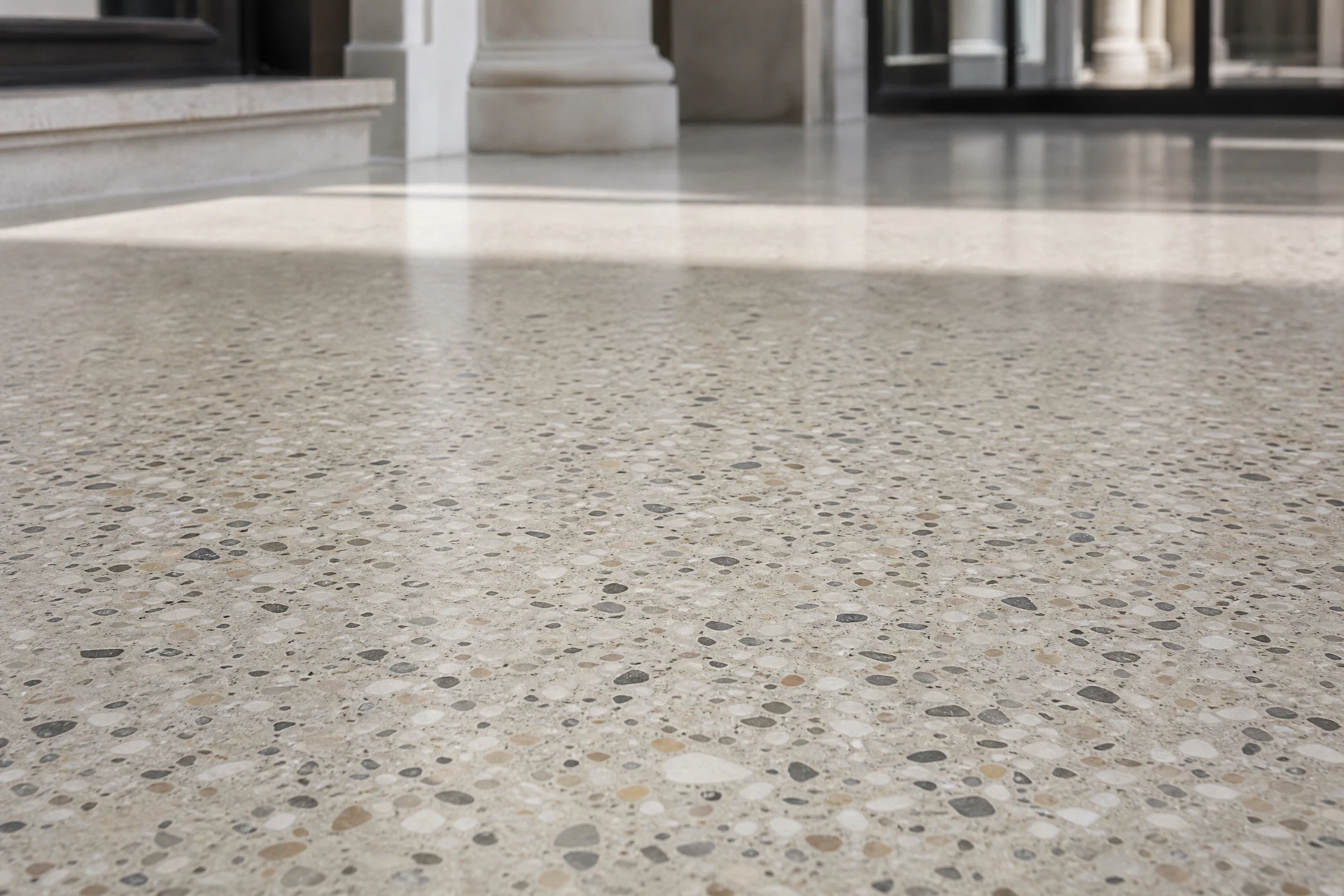
The aesthetic effect arises from the matrix, aggregate, and grinding. Fine grains appear calmer, while larger aggregates define the surface more strongly. To turn a design idea into a resilient surface, the choice of material, installation height, and usage must be decided together.
Grain Size and Buildup Height Belong Together
The grain size determines more than just the appearance. It also influences the required layer thickness and the processing method. VIA specifies different guide values for different grain sizes; however, the substrate, evenness, planned connections, and the specific surface load remain decisive. [1]
Especially in existing buildings, an early comparison with doors, stairs, floor connections, and adjacent trades is worthwhile. Careful sampling helps to make the desired grinding pattern visible before execution.
From Application to Grinding
According to the manufacturer, VIA Terrazzo can be dry-ground after about 24 hours. [1] Nevertheless, the specific construction process must take into account the construction site situation, the climate, and the system approvals. Dry grinding creates a controllable grinding pattern and reduces water entry into the construction site.
Execution requires calm and precision: preparing the substrate, applying the mixture correctly, guiding edges cleanly, building up the grinding in stages, and finally protecting the surface on a project-specific basis. Each of these steps determines the homogeneity of the surface.
An Alternative, Not a General Judgment
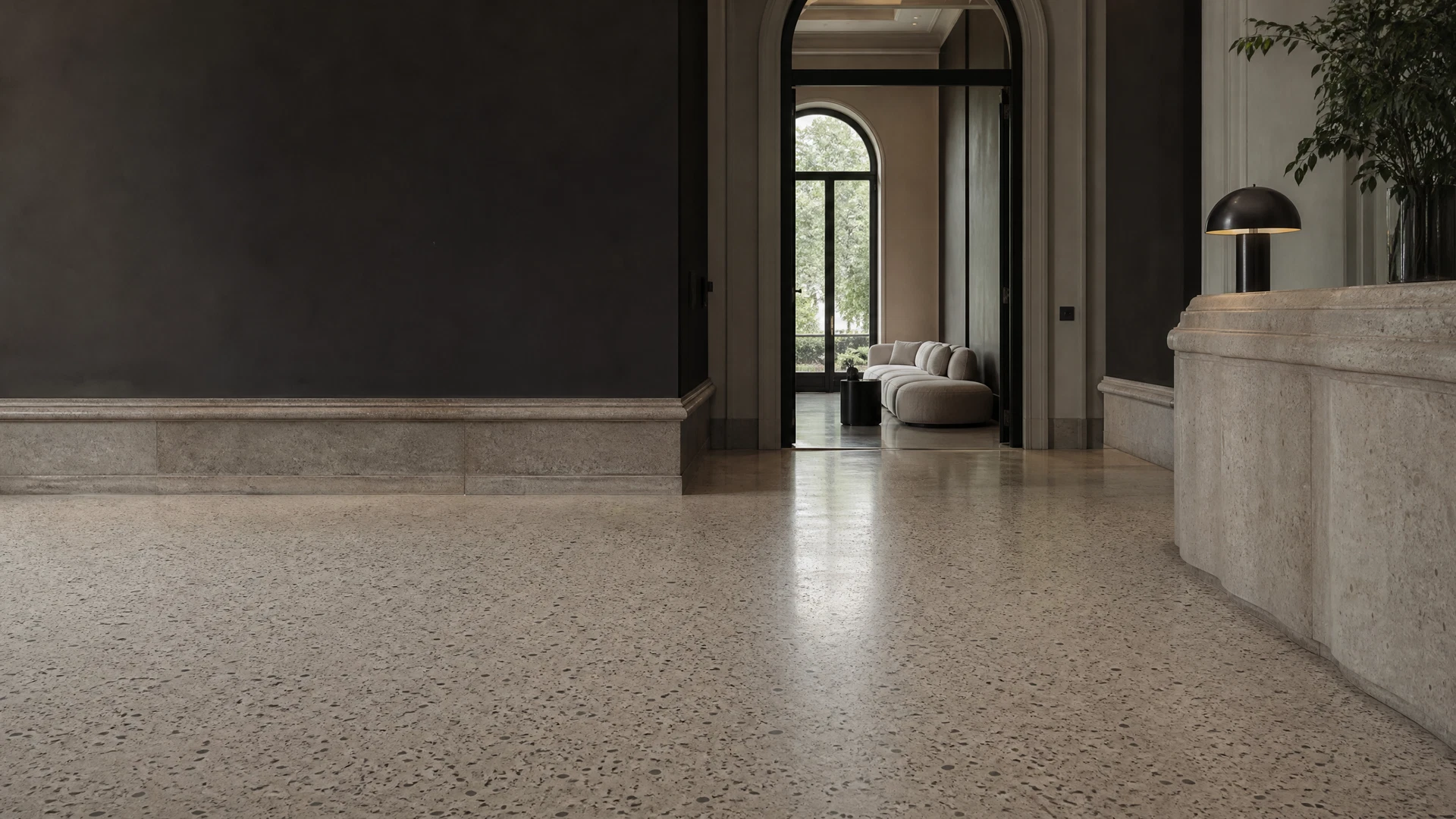
VIA Terrazzo can be an interesting lime-bound alternative to classic cast-in-place terrazzo for certain projects. Whether it is the better solution can only be assessed based on the respective construction project. Statements on sustainability, slip resistance, buildup, or recyclability always require a specific material and object reference.
Care also follows natural stone logic: mild cleaners, no film-forming care layers, and regular monitoring of signs of use. [1] This way, the material-typical effect remains legible.
What to check on site
The decision starts on site.
- Check load-bearing capacity, evenness, and dryness of the substrate
- Plan grain size, installation height, and connections together
- Define usage, rolling traffic, and desired slip resistance
- Coordinate sample area and manufacturer data sheet before execution
Frequently asked questions
Clear answers for the next step.
What are the substrate requirements for installing VIA Terrazzo on underfloor heating systems?
Installation on heated screeds is generally possible. Specific heating protocols and the residual moisture of the substrate must be observed. Before starting work, an object-related inspection of the substrate's levelness and load-bearing capacity is required, as well as coordination with the heating specialist for approval of the flow temperatures.
How does the curing of lime-bound terrazzo differ from cementitious systems?
Unlike cementitious systems, the lime-bound matrix cures through the addition of water glass. This process is shrinkage-free, minimizing the risk of drying cracks. The surface can be dry-sanded after approximately 24 hours. The suitability of ambient conditions such as temperature and humidity must be confirmed on-site through a professional inspection.
What measures are required to protect the open-pored lime surface after sanding?
After surface sanding and cleaning, the surface must be impregnated while dry to reduce the absorption of moisture and dirt. The choice of impregnating agent and the number of applications depend on the planned mechanical and chemical stress. For this purpose, manufacturer approval for the specific object must be obtained.
SteinWert consultation