
This article provides professional guidance. Suitability, execution and legal requirements must always be assessed for the individual property.
A floor with its own material language
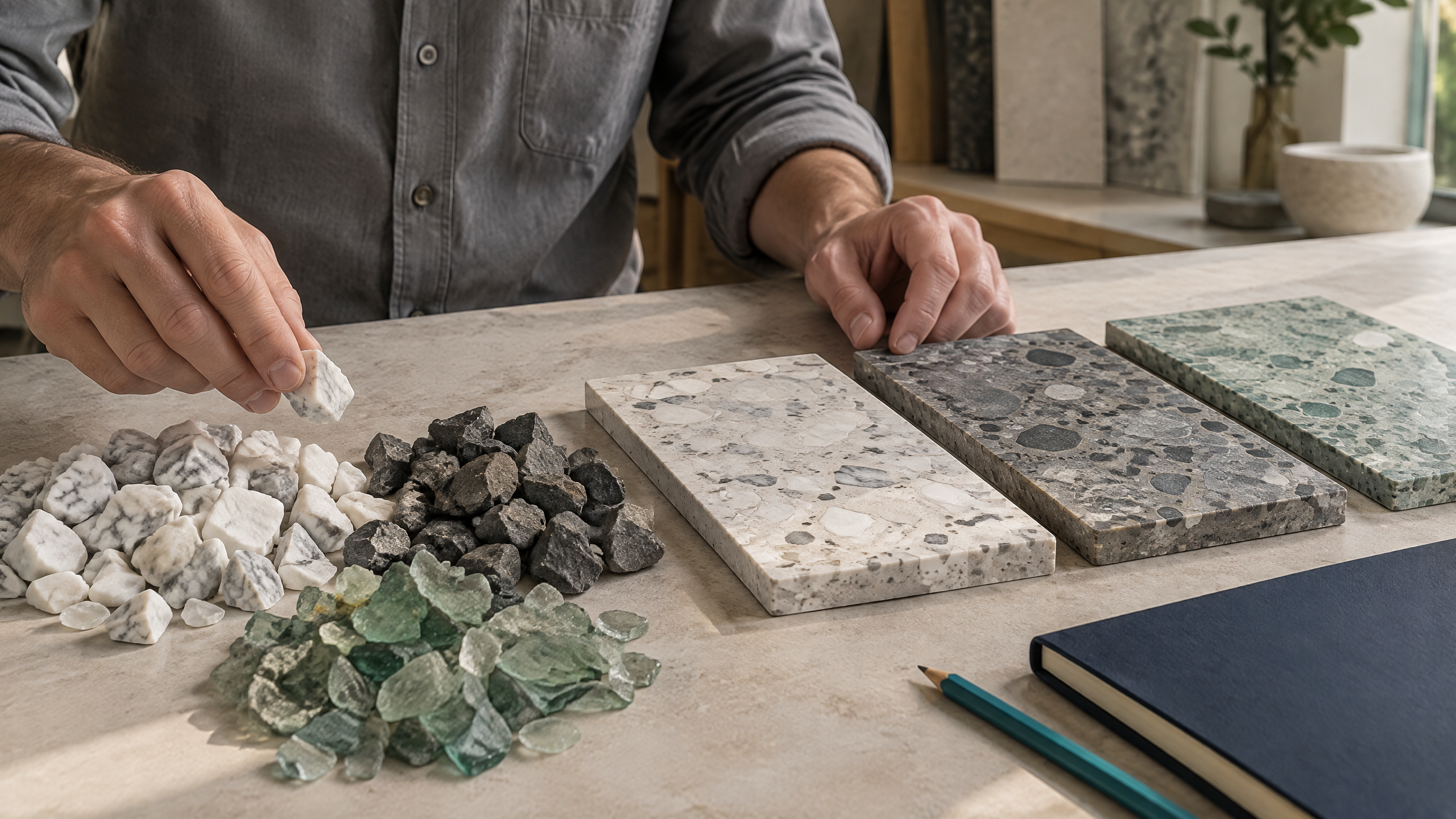
Terrazzo is made from a binder matrix and visible aggregate. The composition does not work like a printed décor: grain, base colour, sanding pattern and light create a surface that changes with the room and the viewing angle.
For VIA Terrazzo, the result is a finely worked mineral floor in the Venetian tradition. The flooring does not become individual only through a rare colour. Its character develops in the relationship between the chosen mix, the detailed planning and the craftsmanship of the finished surface. [1]
Lime and water glass instead of cement and epoxy
VIA describes its terrazzo as lime-bound and activated with water glass. According to the manufacturer, the system is free from cement and epoxy resin. This material composition is one reason why it must be understood as a specific system rather than as a generic terrazzo finish. [1] [2]
Material information is never a substitute for project planning. Substrate, moisture protection, connections, movement joints, intended use and the approved build-up must be reviewed together before installation.

Aggregate, matrix and sanding define the appearance
Light or dark natural stone, glass or other technically tested aggregate can give a floor a calm or more expressive character. VIA also provides individual mixtures; their feasibility, availability and cost require project-specific clarification. [1]
The degree of sanding completes the composition. It determines how openly the aggregate appears and how matte or satin the surface becomes. Grain size, installation height and the desired appearance therefore belong in the same planning discussion. [1] [3]
Variation is part of the craft
A terrazzo surface is not a serially identical product. The position and distribution of the aggregate vary across the area. This is a material characteristic, not a defect to be eliminated in the name of uniformity. [2]
A sample area is the reliable way to discuss the intended combination of aggregate, matrix colour, grain size, edges and finish. It makes the direction visible before a larger area is installed and creates a shared reference for planning and execution.
The construction sequence is part of the result
VIA specifies a dry sanding step after around 24 hours under the applicable system conditions. The real construction sequence still depends on the prepared substrate, climate, area geometry, access, adjacent trades and required approvals. [1] [2]
A suitable execution plan accounts for the load-bearing, level and dry substrate, existing joints and connections, the selected grain size, the sanding reserve and the final protection. The visible surface is therefore the outcome of planning and execution together, not of a material bucket alone. [1] [3]
Care preserves the mineral surface
VIA classifies terrazzo care in line with natural stone: mild, neutral cleaners, no film-forming care layers and a protection system selected for the actual surface. [1]
An impregnation can support resistance to everyday staining on a suitable surface, but it is not an all-purpose guarantee. Usage, soil entry, cleaning process and regular inspection determine the appropriate maintenance interval for the individual property.
What to check on site
The decision starts on site.
- Coordinate aggregate, matrix colour and intended finish with a representative sample
- Review substrate, joints, connections, build-up height and adjacent trades before installation
- Define actual use, rolling loads, moisture exposure and required slip resistance for the project
- Match processing steps and drying conditions to the approved VIA system information
- Plan care, impregnation and routine cleaning in line with the finished mineral surface
Frequently asked questions
Clear answers for the next step.
Why does no VIA Terrazzo surface look exactly the same?
The visible distribution of matrix and aggregate develops as the surface is placed and sanded. VIA describes this variation as a typical terrazzo characteristic. A sample area helps define the intended character together before execution. [1] [2]
Is VIA Terrazzo always jointless?
Large terrazzo areas can create a calm, continuous appearance. Existing substrate movement joints and connections must nevertheless be incorporated into the design and may become a visual detail. The actual build-up determines whether and where joints are required. [1] [3]
Can dry sanding take place after 24 hours on every project?
VIA describes a dry-sanding window after around 24 hours for its system. Whether it is achieved on a project depends on the substrate, climate, layer thickness and binding manufacturer information. Those conditions must be part of execution planning before work begins. [1] [2]
SteinWert consultation
Are you planning a VIA Terrazzo surface in Potsdam, Berlin or Brandenburg? We bring together samples, material logic, detailing and execution planning for the specific project.
Sources and notes
[1] VIA: Terrazzo – ökologisch, robust, schön